

CLARITY IS KINDNESS
by Drew McGee
Buell Early Childhood Leadership Program, Cohort 15*
Research and Evaluation Manager, Early Childhood Solutions LLC
What Clarity Feels Like
Back when I was a budding graduate student, my advisor and I had weekly one-on-ones about projects, the research lab, and life. Because grad school was overwhelming, I sometimes didn’t finish what we needed to move a project forward, or I proposed an idea she didn’t agree with. In those moments, she was direct about what needed to change, why, and what came next. As a new grad student, it was intimidating, but I now look back and see that her candor and clarity was actually kindness.
 To be clear (ha!), the kindness wasn’t receiving the answer I wanted or hearing “It’s okay.” It was knowing where we stood, what was expected, and what would happen next. Clarity is often mistaken for bluntness, being rude, or simply efficiency. But at its best, clarity is a form of kindness.
What Clarity Is
In relationships with other people, clarity requires us to understand and communicate our own values, intentions, and challenges. Clear communication respects people’s time, reduces uncertainty, and builds trust. In relationships, it means stating our needs and boundaries rather than expecting others to guess.

Cohort 15 members Sophie Mariam and Drew McGee chat during a recent BECLP retreat.
Clarity does not mean bluntness, oversimplification, certainty, or straightforward answers. Sometimes the clearest and kindest response is, “We haven’t decided yet,” “I don’t know,” “This may change,” or “Here is when you can expect to hear from me.”
There is a distinction between uncertainty and avoidable ambiguity. Leaders can’t get rid of uncertainty, but they can mitigate it. Honesty from leaders or institutions gives us the information needed to participate, prepare, and make our own decisions.
Professional Partnerships and BECLP
This idea came up in my life from a weekend retreat for the Buell Early Childhood Leadership Program (BECLP) that I am taking part in, born out of one of our cohort working sessions facilitated by MindSpark. The program brings together leaders from across sectors to build authentic relationships, work across differences, and confront challenges in Colorado’s early childhood system. None of this work is possible without trust and understanding, and leaders setting expectations, giving honest feedback, and communicating transparency in decision making.
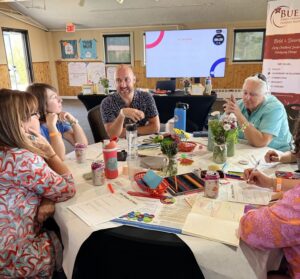
Drew McGee (center) joins BELCN members in discussion at a joint session with the current BECLP cohort.
When working with others, clarity allows people with different roles, experiences, and perspectives to establish shared expectations without assuming that everyone understands a problem (or solution) in the same way. I see this taking shape across several projects in our current BECLP cohort, where fellows use clarity to reshape how information is shared, relationships are built, and communities are invited into the work:
- Kelly Bowes, Stacy Terrill, and Elizabeth Cordova are working through clarity in storytelling; by shifting child care from a private struggle to a shared community priority, this team brings clarity to local narrative assets through open and powerful conversations. They pair targeted outreach with lived experience to turn community connection into lasting, systemic change.
- John Rauscher is tackling a project on how fragmented policies and siloed data currently create friction and delays in early childhood funding. This project uses technology and shared data to map out a clear, interoperable stipend ecosystem—ensuring public dollars reliably reach families and providers when they need them most.
- Lisa Jansen Thompson, Sam Markovitz, Ryad Hussein, Liz Denson, and Sophie Mariam are focusing on rising costs and low sustainability as both families and providers are stretched thin financially. By cutting business costs, bringing employers into the fold, and backing provider-led policy, this initiative aims to create a clear path to lower overhead, affordable care, and a stable workforce.
Part of this process is repeatedly fine-tuning our pitches for what we are doing in these projects for early childhood leaders and collaborators, like Shark Tank for public good. When we are clear in what we are hoping to do and achieve, clarity supports teamwork rather than controls. It gives partners enough information to question, adapt, disagree, and contribute their expertise.
Clarity As an Equity Issue in Systems
In looking at systems, clarity turns insight into coordinated action. Unclear systems do not eliminate work; they transfer it. When things like eligibility requirements, timelines, definitions, or decision-making are difficult to understand, the burden is passed on to the people navigating them, which often means those with the least time, access, and institutional power face the most work. Families are navigating multiple portals to get child care or into preschool, for example, while administrators struggle to figure out who qualifies, where spaces are available, and how much subsidy funding remains. Families and administrators can’t be effectively served by a system they don’t understand.

Current cohort 15 fellows catch up during a day at the capitol. From left: Sam Markovitz, Drew McGee, Kelly Bowes, Christine Bauer, Natalie Holifield, and Elizabeth Cordova.
The principle applies to data: collecting information in human services for those who qualify for programs isn’t enough if we can’t understand what it means, whose experiences it represents, or how it should guide action for programs or for state policies. Data becomes meaningful when people understand:
- what was measured;
- what experiences are represented or missing;
- what choices the data support;
- and what action should follow.
Clear data creates shared understanding, which then supports clearer, more equitable action. If data in any setting is understandable and accessible, people can use them to name a need and communicate why it matters. This understanding helps identify a path toward action while building the support needed to sustain it. Unclear data causes misinformation and more challenges when the goal is to sustain action and solutions.
Ultimately, clarity begins with how we relate to one another. We may not always have the answer someone wants (or any answer at all), but we can be honest about what we know, what we need, and what comes next. That honesty allows people to make their own choices rather than leaving them to guess.
Clarity can’t remove every uncertainty in a situation or resolve every disagreement, but it can ensure that people are not left to navigate or process alone and are working within certain agreed-upon parameters. That is more than efficiency or blunt honesty; it is respect and—at its best—kindness.
* The Buell Early Childhood Leadership Program is currently in its 15th cohort and will soon be accepting applications for the next cohort that will begin in spring 2027. Click here for more information.


